The Work You Can't Check
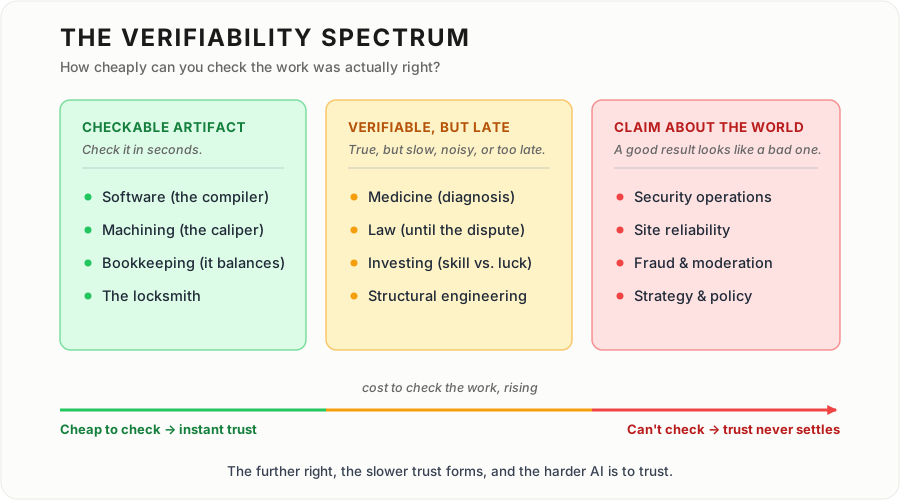 Every kind of work sits somewhere on the dial. The further right, the slower trust forms.
Some work you can check in seconds. Some you can never check at all.
We treat “good work” and “checkable work” as the same thing. They are not, and the gap between them quietly runs entire industries.
Two people do a job for you.
A locksmith says the lock is fixed. You turn the key. Five seconds, no expertise, done. You pay him on the spot.
A night watchman says nothing happened last night. How do you know?
You don’t.
A quiet night looks identical whether he patrolled every hour or slept until dawn. You cannot tell a good watchman from a lucky one by looking at a quiet night.
That difference has a name: verifiability. Not “is the work good?” but “how cheaply can I check that it was actually right?”
It sounds like a small distinction. It runs deeper than that. It decides how fast people trust the work, how it gets priced, how quickly it improves, and now whether AI can do it at all.
Verifiability isn’t a yes or no. It’s a dial. Every kind of work sits somewhere on it, and once you can see the dial you start seeing it everywhere.
The Easy End: A Checkable Artifact
Here the work produces something you can hold against a fixed standard and grade in moments.
Software. Code runs or it doesn’t. The compiler and the test suite are a free, merciless judge that answers in seconds. Keep this one in mind. It explains more than you’d think.
Machining a part. The caliper says it’s within tolerance or it says it isn’t. Physical measurement is the answer key.
Bookkeeping. The books balance or they don’t. Double-entry accounting is a verification machine disguised as a filing system.
The locksmith. Turn the key.
Different fields, same shape: a closed standard, a cheap check, an instant verdict. Work like this earns trust fast. You pay on completion. You don’t ask for references.
The Middle: Verifiable, But Slowly
Here the truth exists, but reaching it is expensive, delayed, or drowned in noise.
Medicine. A surgeon often closes hard. The joint works or it doesn’t. A diagnosis is softer. You may learn whether it was right only later, through outcomes confounded by everything else in the patient’s life. Two doctors make the same call, and the one who was wrong can look identical to the one who was right for years.
Law. A contract is a checkable artifact. You can read it. But whether it was good law is only tested when a dispute arrives, sometimes a decade later, if ever.
Structural engineering. The bridge stands, which tells you nothing about the margin of safety, until the rare day it doesn’t, catastrophically. When the outcome arrives too late or too rarely to learn from, the field stops waiting for it and verifies against codes and simulations instead.
Investing. Returns are real ground truth, but so noisy that skill and luck are nearly impossible to separate over any short window. A quiet, up year looks the same whether the manager was brilliant or fortunate. The watchman, in a suit.
The Hard End: A Claim About a Hidden World
Here the work produces an assertion about a system that is partly invisible, and sometimes actively fighting you.
This is a different problem from the middle of the dial. Investing is noisy, but the market isn’t trying to fool you. Here, something on the other side is working to make sure a careful check and a careless one produce the same quiet result.
Security operations. The core product of a security team, thousands of times a day, is the sentence “we checked, nothing is wrong.” You cannot verify that by reading it. To actually check, you would have to re-investigate reality, against an adversary whose whole job was to make the dangerous thing look boring. It is the hardest case on this whole spectrum, and worth its own deep dive.
Intelligence. Site reliability. Fraud and content moderation. Same shape: “we caught what mattered.” Did you? The misses don’t announce themselves. You are blindest exactly where it counts.
Strategy, policy, management. Did the decision cause the outcome, or would it have happened anyway? There is no counterfactual to check against. The result arrives years later, tangled with a thousand other causes.
This is the watchman’s end of the dial. Not because the people are worse. Often they’re the best in the building. It’s because the work is structurally unprovable.
Everyone at the Hard End Does the Same Thing
Look at what every field at the hard end reaches for. It’s the same substitute every time.
When you can’t verify the outcome, you verify the process instead.
Medicine has clinical guidelines and board certification. Engineering has building codes. Security has audits and compliance frameworks. Education has standardized tests. Each one certifies that you followed the method believed to produce good work, not that the work was actually right.
Process is a proxy for verification, and it’s necessary. You can’t run a hospital or a power grid on vibes. But never lose sight of what it is. It certifies the recipe, not the meal. The gap between “followed the method” and “got it right” can widen silently for years while every audit comes back clean. That’s not hypothetical. It’s the failure mode hiding behind a surprising share of the disasters we act shocked by afterward.
There’s a second tell, and once you see it you’ll spot it in every negotiation. Unverifiable work is trusted slowly and priced nervously. You don’t pay the watchman and wave him off. You check references. You install a camera to watch the watchman. And where the work truly can’t be checked, we wrap it in accountability instead: a license to revoke, an insurer behind it, a name on the line, someone to fire. Accountability is what we buy when verification isn’t for sale. It’s the tax the hard end of the dial pays, forever.
Why This Is About to Matter More
For most of history, verifiability was a fixed feature of the work. You couldn’t move a job along the dial. You just priced it accordingly.
AI changes the stakes, because the dial turns out to predict where AI creates value with unusual precision.
Where checking is cheap, AI compounds fast. It’s no accident that coding was among the first things AI got genuinely great at. That free, merciless compiler is the perfect training partner. The machine could be corrected a billion times, for free, against ground truth.
Where checking is expensive, AI stalls, no matter how capable the model gets. If you can’t tell a brilliant answer from a lucky one, you can’t trust the machine, and you can’t teach it. A superhumanly smart agent at the watchman’s end of the dial is still just a very articulate watchman. You have no way to know if it’s any good.
And it sharpens over time. Producing answers keeps getting cheaper. Checking them doesn’t. So the dial, not raw intelligence, increasingly decides which industries AI transforms and which it merely unsettles.
Which points at an odd conclusion. The bottleneck was never the model. At the hard end of the dial, the constraint has always been the check, not the answer. So the most valuable work of the next decade isn’t building a smarter machine. It’s manufacturing verification where none existed, a cheap, trustworthy check for work that never came with one. Turning watchman problems into locksmith problems.
That’s a strange new job, and few companies are hiring for it by that name yet. But it’s the job. Wherever someone finds a way to verify the unverifiable, an entire industry slides left on the dial, and AI walks in right behind it.
Before you ask whether a piece of work is good, ask whether you could even tell. That’s verifiability. Most people have never named it. It’s been quietly sorting the winners the whole time, and it’s about to decide which industries AI actually gets to keep.