Impedance Mismatch: The Data Engineering Challenge at the Heart of Security Operations
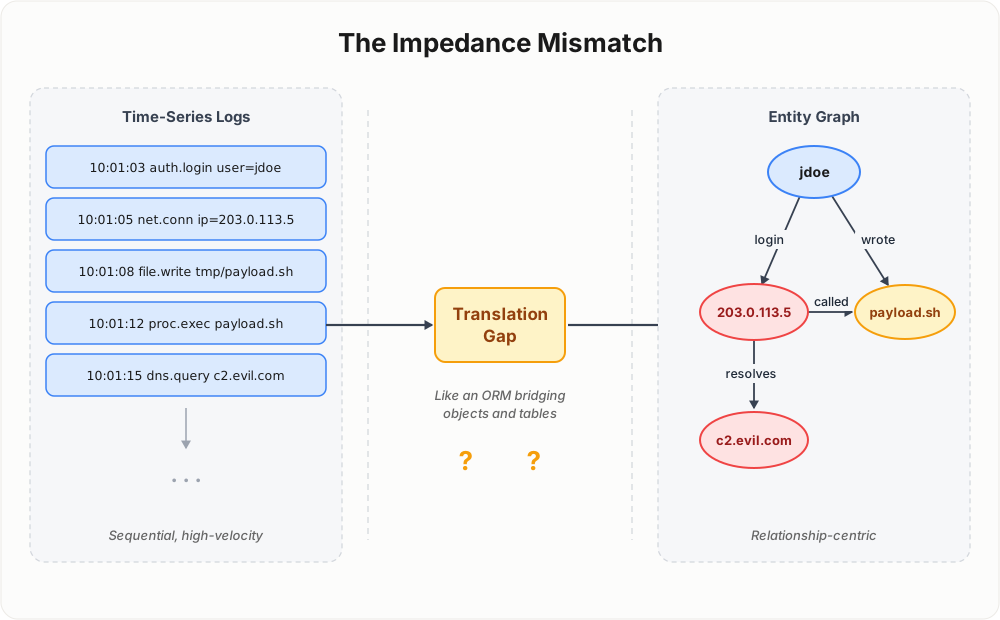 Security reasoning is graph-shaped, but data arrives as sequential logs - bridging that gap is the core engineering challenge.
In Security Operations (SecOps), effective reasoning is highly graph-based. Graphs naturally support entity linkage, allowing analysts to trace relationships between seemingly disparate entities like IP addresses, files, and users involved in an incident. Security ontologies and taxonomies (such as MITRE ATT&CK or CVEs) fit well within this graph structure, making it ideal for connecting and understanding security data.
So, where does the challenge arise?
Most systems within an organization produce logs, which typically come as unstructured or semi-structured time-series data. Logs are optimized for fast, sequential storage rather than relationship-centric querying. This creates an “impedance mismatch” - a classic data engineering challenge similar to integrating object-oriented code with relational databases. In database engineering, relational tables and object-oriented data structures don’t naturally align, requiring additional layers, like ORMs, to bridge the gap.
In SecOps, the mismatch appears because:
- Logs arrive as high-volume, high-velocity time-stamped events optimized for sequential access
- Effective SecOps analysis requires linking entities and relationships - a structure more naturally represented in a graph
- Converting raw logs into a graph-based format can be computationally intense and may introduce delays if not managed effectively