Why Every Dismissed Alert Is Technical Debt
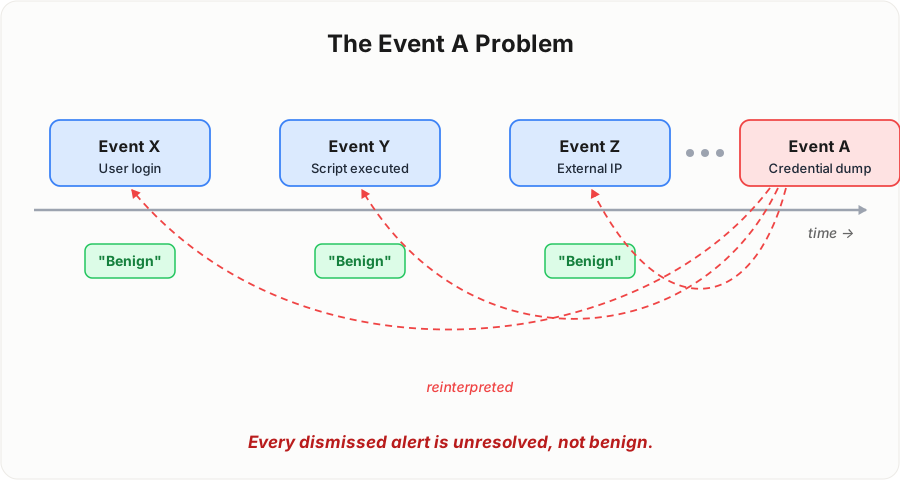 Maliciousness is not inherent in the event - it emerges from its relationship to future context.
Most of us treat a security alert like a closed case. You investigate events X, Y, and Z. You see no malice. You dismiss the alert.
But there’s a fundamental flaw in this logic that I’ve started calling the Event A Problem.
The “maliciousness” of an event is not an inherent property of the event itself. It’s a property of its relationship to future context.
A user logs in, runs a script, connects to an external IP. Today it looks like routine maintenance. But six months later, Event A occurs - a credential dump surfaces on a dark web forum.
Suddenly the meaning of those original events changes. They weren’t maintenance. They were initial access.
This creates three uncomfortable realities for security operations:
- Every event exists in epistemic limbo. Until Event A occurs (or enough time passes to make it implausible), events can’t be definitively classified. They’re not benign. They’re unresolved.
- Baseline poisoning undermines detection. UEBA assumes your baseline represents legitimate behavior. But if an attacker establishes persistence during the learning window, you’re not detecting anomalies - you’re learning to ignore the intrusion.
- Dismissal is deferral, not resolution. When you close an alert as benign, you’re not making a permanent determination. You’re making a provisional judgment contingent on a future that hasn’t happened yet.
The implication: we don’t just need better detection. We need recursive context-architectures that maintain queryable history so that when Event A finally surfaces, you can re-evaluate months of “resolved” alerts in seconds rather than weeks.
Every dismissed alert is a liability on your balance sheet. The question is whether you’ve built the infrastructure to audit it when the future arrives.