AI SOC Rewrites the Shared Responsibility Contract
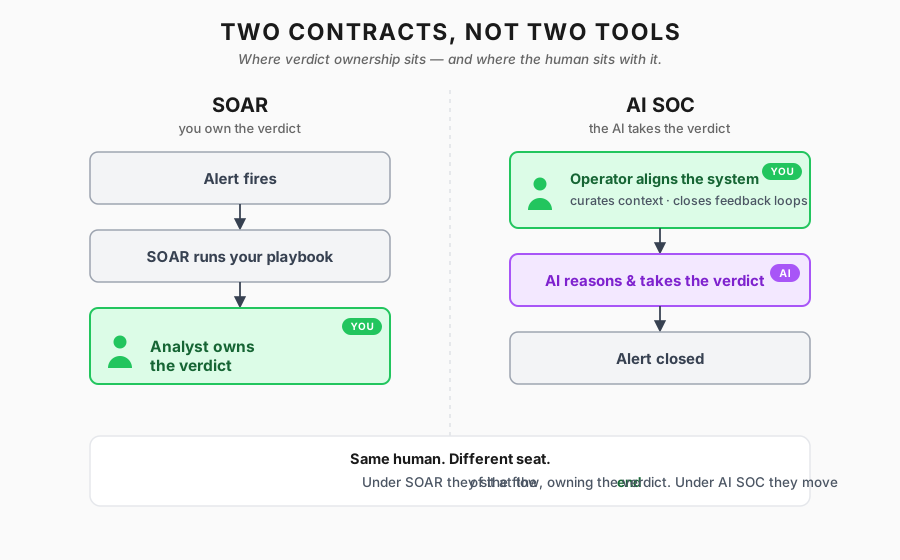 Same human, different seat: SOAR keeps you at the verdict, AI SOC moves you upstream to alignment.
SOAR and AI SOC aren’t two flavors of the same tool. They’re two different contracts with your vendor.
Every security platform runs on a shared responsibility model - an implicit agreement about who owns which part of the work. Most teams haven’t noticed that AI SOC rewrites those terms entirely. They buy it as a faster SOAR, staff it like a faster SOAR, and then wonder why the value never shows up.
To see why, start with the contract you already have.
The SOAR contract
With SOAR, the terms are clear:
- The vendor builds the automation engine.
- You write the playbooks.
- You own the verdict.
An alert fires. SOAR runs your playbook - enriches, correlates, pivots across tools. Then the analyst looks at the result and decides whether it mattered. Verdict ownership never left the analyst. SOAR just made them faster at getting to the decision.
That’s the whole deal. Automation compresses the mechanical work between “alert fired” and “human decides.” The human still decides. Every playbook you write is an instruction you would have carried out yourself, encoded so a machine can carry it out instead.
AI SOC is a different genre
AI SOC doesn’t just recommend the verdict. It takes it.
That is not a faster version of the SOAR contract - it’s a different contract. The clause that never moved under SOAR, verdict ownership, is exactly the clause that moves here. The AI reasons over the context, reaches a conclusion, and closes the alert. The human is no longer in the path of every decision.
Here’s what gets missed: shifting verdict ownership to the AI doesn’t eliminate the operator’s work. It transforms it.
The instinct is to read “the AI takes the verdict” as “the analyst is removed.” But the verdict is only as good as the context the AI reasons from and the feedback loop that corrects it when it’s wrong. Someone has to own that. That someone is your operator - just doing a different job than before.
From queue monitor to alignment operator
Under the SOAR contract, the operator’s job is to monitor the alert queue and render verdicts. Under the AI SOC contract, that job changes shape:
- Curating the context the AI reasons from.
- Closing feedback loops when verdicts are wrong.
- Aligning the system to your environment’s threat model.
That’s not analyst work. That’s alignment work.
It’s a harder job than queue monitoring, and it sits upstream of every verdict the system produces. A queue monitor affects one alert at a time. An alignment operator affects the reasoning that decides thousands. The leverage is enormous - and so is the cost of staffing the role as if nothing changed.
The optimization error
Teams treating AI SOC like a smarter SOAR are optimizing the wrong variable. They measure success in alerts-per-analyst and tune for throughput on a queue the AI is supposed to be draining. They’re staffing queue monitors when they desperately need alignment operators.
The trap is that the new contract’s most important work is nearly invisible on a performance review. Nobody gets promoted for “the AI was wrong less this quarter.” So the role tends to get created reactively - after the first visible miss - rather than deliberately, up front.
That’s partly on the buyers, but mostly on the vendors. The teams adopting these platforms are pattern-matching to SOAR because it’s the only frame they have. It’s on the people building AI SOC to make the alignment work legible and rewarded first - to define what good operator behavior looks like in this new model before the first miss defines it for them.
If you’re bringing AI SOC into your environment, the question to ask isn’t “how many alerts can my analysts clear?” It’s “who owns the context and the feedback loops the AI reasons from - and do they know that’s the job?”